
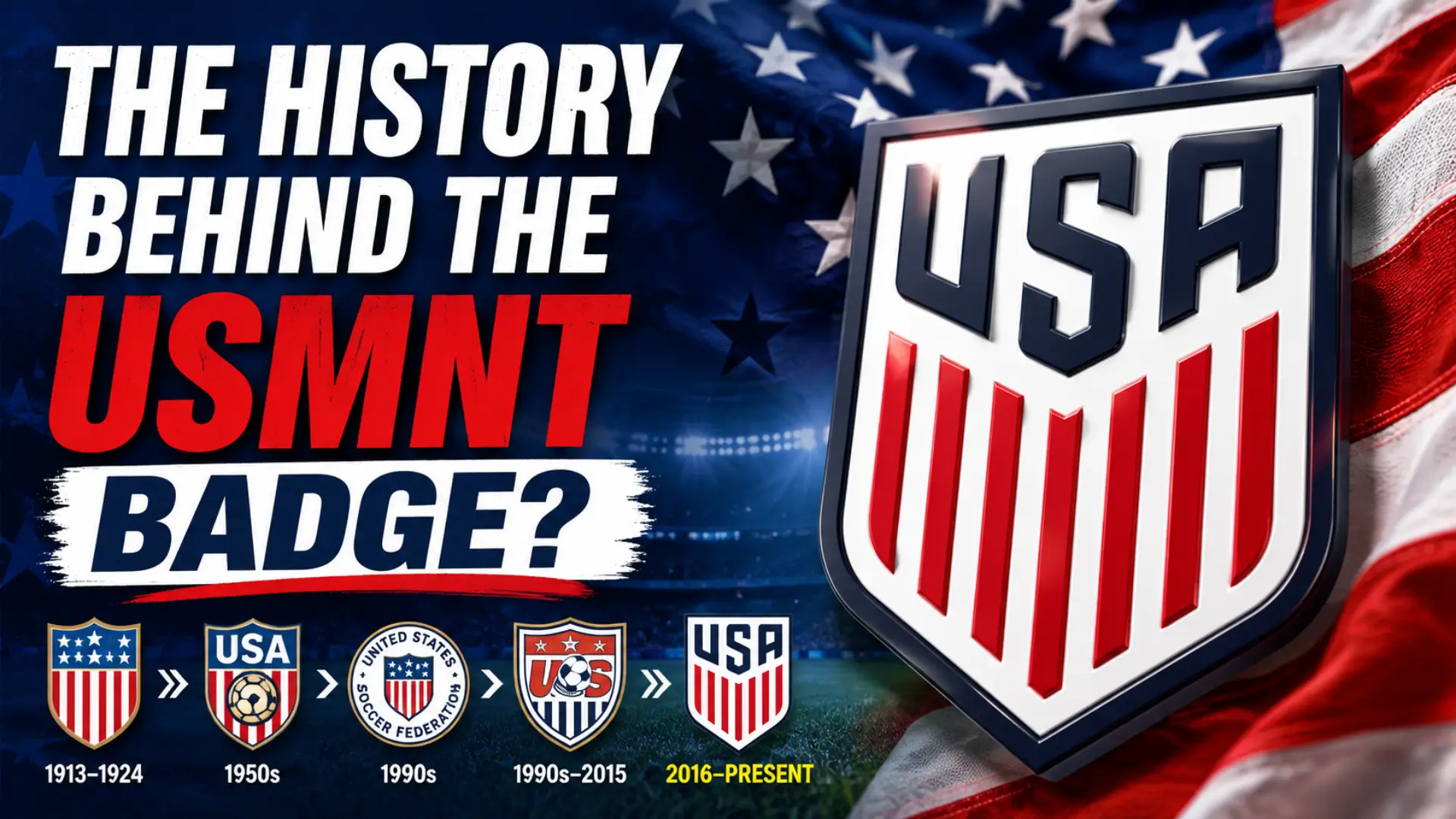
History Behind the USMNT Badge?
The USMNT badge is one of the most recognizable symbols in American soccer. When the United States men’s national soccer team walks onto the field, the crest on the shirt represents much more than a simple team logo. It connects the players with the country, the history of U.S. Soccer and generations of fans who have followed the national team.
The badge has not always looked the way it does today. Over the years, U.S. Soccer has used several different designs, including shields, stars, soccer balls, lettering and American flag-inspired patterns. Each version reflected a different period in the growth of soccer in the United States. The modern badge is much simpler, but its design still carries a strong connection to the American flag and national identity.
You Can Also Read: Lindsey Graham Cause of Death What Happened to the Former US Senator
What Does USMNT Stand For?
USMNT stands for United States Men’s National Team. It is the common name used for the U.S. men’s national soccer team, which represents the United States in international competitions. The team is operated under the United States Soccer Federation, commonly known as U.S. Soccer.
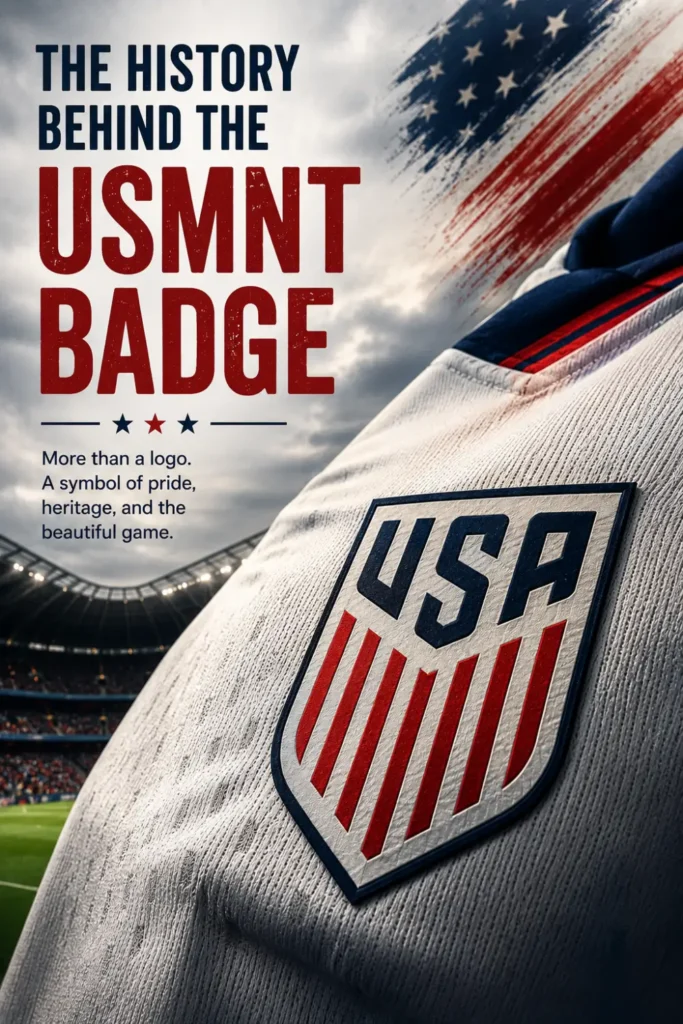
The USMNT badge therefore represents the national team rather than a normal professional club. Unlike club badges, which often include a city, nickname or founding date, the American national team crest is designed around the identity of the country. The word “USA” and the red, white and blue design make that purpose clear.
- USMNT means United States Men’s National Team
- The team represents the United States internationally
- U.S. Soccer oversees the national team
- The badge is connected to American national identity
- The crest appears on the team’s official uniforms
When Did the US Soccer Badge First Appear?
The history of the U.S. Soccer badge goes back more than a century. Early versions of the emblem were closely connected to the American flag rather than to soccer itself. The earliest known crest used by the federation from 1913 to 1924 essentially reflected the country’s national colors and flag design.
This makes sense when considering the role of a national team. In the early years, the most important message was simply identifying the team as representing the United States. There was no need for an elaborate soccer-specific symbol. The American flag already provided a powerful and recognizable identity.
- Early designs used stars and stripes
- The first known version dates to 1913
- National identity was more important than soccer imagery
- The badge changed several times during the early decades
- U.S. Soccer gradually developed a more distinct visual identity
You Can Also Read:Maryam Nawaz Rehmat Card Login Guide for 1Lakh Payment & Eligibility Updates
The Early American Soccer Crests
The first decades of U.S. Soccer were marked by several different badge designs. Rather than keeping one logo for many years, the federation experimented with different ways to represent the national team. Historical records show several versions between the 1910s and the middle of the 20th century.
These early designs are important because they show that the U.S. Soccer crest has always been connected to American identity. Some versions were based heavily on the national flag, while others introduced different shapes and lettering. The exact appearance changed, but the basic idea remained the same: the badge had to identify the United States.
| Period | General badge style |
|---|---|
| 1913–1924 | Flag-inspired shield |
| 1920s–1930s | Several changing national designs |
| 1950s | American colors and national imagery |
| 1960s–1970s | Simplified federation marks |
| 1980s | Shield-based designs return |
| 1990s–2015 | Soccer-focused shield and lettering |
| 2016–present | Modern USA shield |
The large number of early versions also shows how different the modern USMNT badge is from the team’s earliest identity. The crest was not created as one permanent design from the beginning. Instead, it developed gradually as the federation and the sport became more established.
You Can Also Read: Aghosh Program Online Check by CNIC to Verify Payment & Eligibility Know Details 2026
Why Does the USMNT Badge Use Red White and Blue?
The most obvious feature of the badge is its use of red, white and blue. These are the colors of the American flag, so their presence immediately connects the soccer team with the United States. The colors also make the crest easy to recognize when it appears on a national team shirt.
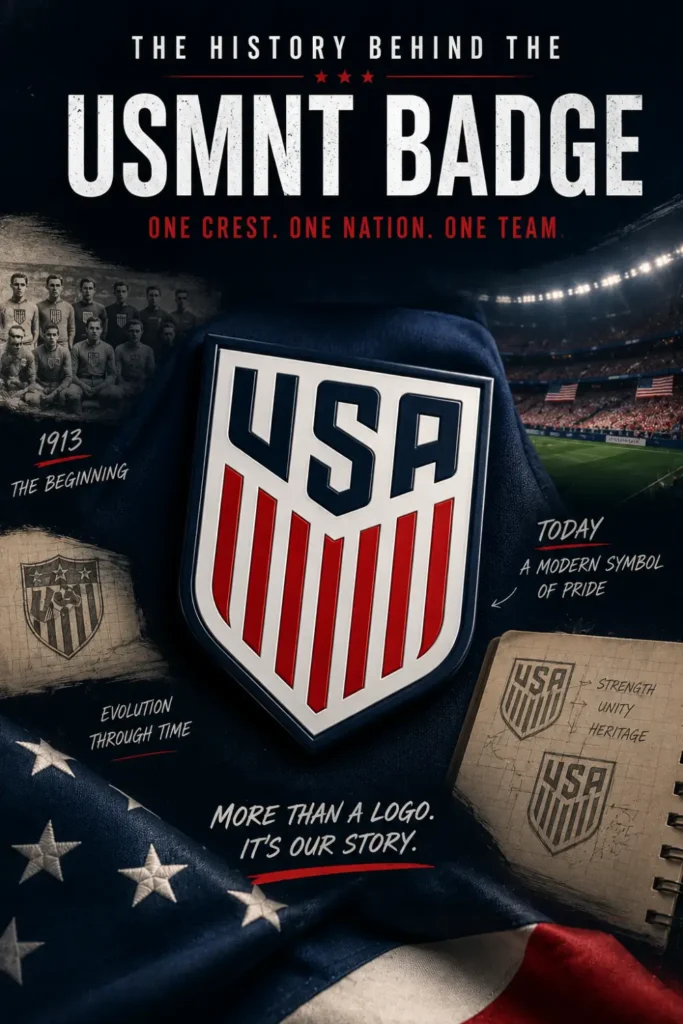
This connection between soccer and the flag has been present throughout much of U.S. Soccer history. Even when the shape and details of the badge changed, American colors remained an important part of the visual identity. The modern crest continues that tradition in a much cleaner form.
- Red connects the crest to the American flag
- White provides the central background
- Blue is used for the lettering and surrounding elements
- The colors create a strong national identity
- The design works on both soccer shirts and other merchandise
The Return of the Shield
The shield has played an important role in the history of the U.S. Soccer badge. After several decades in which different logos and wordmarks were used, a shield-based identity became more prominent again during the 1980s.
A shield is a common shape in sports and national team crests because it can suggest tradition, strength and identity. For U.S. Soccer, it also created a clear space for American colors and lettering. The shield became an important part of the visual language that eventually led to the modern crest.
The 1984 design was particularly significant because it combined a USA wordmark with a separate soccer-related emblem. It was not yet the modern badge, but it represented a move toward creating an identity specifically for American soccer rather than simply reproducing national imagery.
- The shield became a recurring design element
- USA lettering became increasingly important
- Soccer imagery began appearing more clearly
- The designs moved away from simply copying the flag
- These changes helped shape later U.S. Soccer branding
You Can Also Read: Federal Pension Increase 2026: Government Announces 7% Raise for Retired Employees
The 1990s and the 1994 World Cup
The 1990s were a major period for American soccer. The United States hosted the 1994 FIFA World Cup, giving the sport an enormous opportunity to reach a wider American audience. This period also coincided with major changes in the national team’s identity.
Around the same era, U.S. Soccer adopted a more recognizable soccer-oriented crest. The design used a shield, “US” lettering and a moving soccer ball, creating a much stronger connection between the national identity and the sport itself.
The timing was important. Hosting the 1994 World Cup helped bring American soccer into the national spotlight, and the badge became part of that larger visual identity. It appeared during a period when the United States was building a stronger foundation for professional and international soccer.
- The 1994 World Cup was hosted in the United States
- Soccer received greater attention across the country
- The national team’s visual identity became more recognizable
- Soccer imagery became a major part of the badge
- The 1990s helped establish modern American soccer culture
The Famous Soccer Ball Badge
One of the most recognizable older U.S. Soccer crests featured a soccer ball moving across the design. The ball gave the logo a sense of speed and action, while the surrounding shield connected it to the national team.
This badge remained associated with U.S. Soccer for many years. It was very different from the current crest because it contained more visual elements. The soccer ball immediately told viewers what the organization represented, while the lettering and shield helped establish its national identity.
The older badge is still remembered by many American soccer supporters because it was used during an important period in the growth of the national team. It became familiar to fans who watched the USMNT compete in several World Cups and major international tournaments.
- The soccer ball created a direct connection to the sport
- The shield maintained a national-team appearance
- The design used American colors
- The crest was more detailed than the modern version
- It became closely associated with American soccer in the 1990s and 2000s
You Can Also Read: Pak ID App Update 5.6.8: NADRA Adds Digital Vehicle Services in Balochistan
What Did the Three Stars on the Old Badge Mean?
One of the most interesting details about the older U.S. Soccer logo was its three stars. These stars are sometimes confused with championship stars that appear above national team badges in other countries.
However, the three stars on the older U.S. Soccer logo were part of the design itself. They were not a count of FIFA World Cup titles won by the men’s national team. This distinction is important because the USMNT has never won the men’s FIFA World Cup.
The current USMNT crest does not have those three stars. Instead, it focuses on the USA lettering and American flag-inspired stripes. The change removed a feature that could easily create confusion about the team’s international achievements.
- The old logo included three stars
- They were decorative design elements
- They did not represent three men’s World Cup titles
- The current USMNT crest does not use those three stars
- The men’s team has not won the FIFA World Cup
You Can Also Read: Himmat Card Payment Withdrawal Guide – Easy Method to Withdraw Rs 10,500 from ATM
Why Does the USMNT Badge Have No Stars?
The lack of stars on the current USMNT badge is intentional. In modern international soccer, stars above a national team crest are commonly associated with World Cup championships. Since the United States men’s team has not won a FIFA World Cup, there are no championship stars above its current badge.
This is different from the United States women’s national team. The USWNT has won four Women’s World Cup titles, and its shirts carry four stars to represent those championships. U.S. Soccer has explained that the fourth star was added following the women’s 2019 World Cup victory.
| Team | World Cup titles | Stars currently associated with World Cup titles |
|---|---|---|
| USMNT | 0 | 0 |
| USWNT | 4 | 4 |
The difference can sometimes confuse casual fans because both teams use the same basic U.S. Soccer shield. The stars are separate from the core crest and can change according to the team’s championship history.
The 2016 U.S. Soccer Badge Redesign
The biggest modern change came in 2016. U.S. Soccer introduced a redesigned crest that was much simpler than the previous version. The soccer ball disappeared, the old decorative stars were removed and the badge became centered on the word “USA” and American flag-inspired stripes.
The redesign created a cleaner identity that could work across many different uses. It was designed to be recognizable on soccer shirts, digital platforms, merchandise and other U.S. Soccer materials. The result was a badge that looked more modern while still being connected to the country’s history.
The current crest consists primarily of a shield with “USA” across the upper section and red and white vertical stripes below. The blue elements provide contrast and reinforce the connection to the American flag.
- The current crest was introduced in 2016
- The soccer ball was removed
- The three decorative stars were removed
- USA became the most prominent wording
- Red and white stripes became the central visual feature
- The shield remained an important part of the identity
You Can Also Read: Maryam Nawaz Rehmat Card Login Guide for 1Lakh Payment & Eligibility Updates
Why Are the Stripes Vertical on the USMNT Badge?
The red and white stripes are one of the most important visual elements in the current badge. They are inspired by the stripes of the American flag, but they are arranged vertically inside the shield rather than appearing exactly as they do on the flag.
This creates a simple visual connection between the national team and the United States. A person does not need to know the history of American soccer to understand what the colors and stripes are trying to communicate. The badge is essentially using a familiar national symbol in a soccer-specific format.
The design also gives the crest a cleaner appearance. Instead of filling the badge with many different symbols, U.S. Soccer uses a small number of recognizable elements to communicate the team’s identity.
- The stripes reference the American flag
- Red and white dominate the lower section
- The stripes create a strong visual pattern
- The design avoids unnecessary decoration
- The national identity remains clear even without a soccer ball
Why Does the Badge Say USA Instead of USMNT?
The current crest uses “USA” rather than the abbreviation “USMNT.” This is an important distinction because the badge represents the United States rather than simply describing the team by its commonly used nickname.
When the national team plays an international opponent, “USA” clearly identifies the country being represented. It is short, recognizable and understood around the world.
USMNT is mainly a term used by fans, media outlets and soccer organizations when talking about the men’s team. It is not necessary for the crest itself because the national flag colors and “USA” lettering already communicate the team’s identity.
- USA identifies the country
- USMNT identifies the men’s national team
- The badge needs to work internationally
- Short lettering makes the crest easier to recognize
- The design can also represent U.S. Soccer beyond one team
You Can Also Read: Aghosh Program Online Check by CNIC to Verify Payment & Eligibility Know Details 2026
How the Badge Became More Minimal?
The move from the older soccer-ball crest to the modern shield reflects a broader change in sports branding. Many modern sports organizations prefer simple marks that remain recognizable when displayed at different sizes.
The 2016 U.S. Soccer crest followed this approach. Removing the soccer ball and decorative stars made the badge less complicated. The remaining elements were strong enough to communicate the identity without requiring several separate symbols.
This also made the crest easier to use across modern media. A simple design can work on a large stadium banner, a soccer shirt, a mobile screen or a small social media image without losing its main features.
- Fewer symbols make the crest easier to recognize
- The USA lettering is highly visible
- The stripes provide a strong visual identity
- The shield keeps a traditional sports appearance
- The design works across digital and physical formats
How the Badge Changed With American Soccer?
The history of the badge mirrors the development of soccer in the United States. In the early years, the national team had a relatively limited place in American sports culture. Its crest therefore relied heavily on national symbols.
As soccer became more organized and professional, U.S. Soccer developed more specific branding. The creation and growth of professional soccer, the return of the United States to the World Cup stage and the hosting of the 1994 World Cup all contributed to a more recognizable soccer identity.
U.S. Soccer’s own historical timeline notes major changes in the organization and American soccer landscape during this period, including the federation’s 1974 name change and the growth of professional soccer around the NASL era.
- Early badges focused heavily on the country
- Later designs emphasized soccer
- Professional soccer helped grow the sport
- World Cup appearances increased visibility
- The modern crest combines both national and soccer identities
You Can Also Read: Federal Pension Increase 2026: Government Announces 7% Raise for Retired Employees
The Badge and USMNT World Cup History
The badge has appeared through many important moments in USMNT history. The United States reached the semifinals of the inaugural 1930 World Cup and was later famously involved in the 1950 tournament, when it defeated England in one of the competition’s most famous upsets.
The modern era brought more regular World Cup appearances. The team returned to the tournament in 1990 after a long absence, hosted the tournament in 1994 and continued building a more consistent international presence. The crest changed during these decades, meaning each generation of supporters can associate different badge designs with different periods of USMNT history.
The badge itself does not determine what happens on the field, but it becomes part of the memory of those matches. Fans remember certain shirts, players and tournaments together with the crest that appeared on the chest.
The Badge During the 2000s
The U.S. Soccer crest used during much of the 2000s was more decorative than the current design. It featured a shield, strong colors, lettering, stars and a soccer ball element.
This was also a successful period in parts of USMNT history. The United States reached the quarterfinals of the 2002 World Cup, producing one of its strongest World Cup performances. The team also continued competing regularly in CONCACAF competitions.
The older crest therefore became connected to an important generation of American players. For supporters, the badge was not simply a graphic. It appeared on shirts worn by players who helped raise the profile of the national team.
- The crest featured more visual elements
- A soccer ball was part of the design
- Stars appeared within the badge
- The United States had strong tournament moments
- The badge became familiar to a generation of fans
You Can Also Read: Pak ID App Update 5.6.8: NADRA Adds Digital Vehicle Services in Balochistan
The Difference Between a Crest and a Logo
People often use “badge,” “crest” and “logo” to mean the same thing, but there is a small difference in how these terms are commonly used in sports.
A logo is a broad term for a visual identity. A crest usually refers to a shield-shaped emblem associated with a sports team or organization. A badge can describe the emblem placed on a team’s uniform. The USMNT badge can therefore be described using all three terms depending on the context.
The current U.S. Soccer design works especially well as a crest because of its shield shape. At the same time, it functions as the organization’s logo and appears as a badge on the national team’s shirts.
- Logo is the broadest term
- Crest often refers to a shield-style emblem
- Badge commonly refers to the emblem worn on a uniform
- The USMNT design can be described in all three ways
- The shield gives the current design a traditional sports feel
Why the Current USMNT Badge Is So Simple?
The simplicity of the current crest is one of its defining characteristics. There is no soccer ball crossing the shield, no large collection of decorative symbols and no complicated illustration. Instead, the design relies on three basic ideas: USA, American colors and flag-inspired stripes.
This simplicity makes the badge easy to remember. When fans see the shield, they can quickly recognize the national team. The design also gives U.S. Soccer flexibility because it can be used across uniforms, merchandise, digital platforms and promotional material.
The modern badge is therefore less about showing everything connected to American soccer and more about creating one clear symbol that represents the organization.
Is the USMNT Badge the Same as the U.S. Soccer Badge?
The USMNT wears the U.S. Soccer Federation’s crest as its main national-team badge. The same core crest is also associated with U.S. Soccer’s national teams, although uniform details such as stars can differ between the men’s and women’s teams.
This is why the USWNT can have four stars while the USMNT does not. The basic shield remains recognizable as the U.S. Soccer identity, while the stars communicate the women’s team’s World Cup championships.
The shared crest also reflects the fact that both national teams represent the same country and operate under the same soccer federation.
- The USMNT uses the U.S. Soccer crest
- The USWNT also uses the core U.S. Soccer identity
- Stars can differ based on championship history
- The shield provides a common national identity
- Uniform design can change without changing the basic crest
How the Badge Fits Into the 2026 Era
The current generation of USMNT supporters is seeing the crest during an especially important period for American soccer. The United States is one of the co-hosts of the 2026 FIFA World Cup, alongside Canada and Mexico.
U.S. Soccer and Nike introduced new national-team kits ahead of the 2026 tournament, with the federation describing a player-led design process. The new collection also includes custom “Stars and Stripes” typefaces developed for U.S. Soccer.
The badge therefore sits within a much larger visual identity surrounding the 2026 World Cup. While the crest itself represents the national team, the shirts, fonts, colors and other design elements are being used to create a broader identity for American soccer.
What Makes the USMNT Badge Different From Club Badges?
A club badge usually represents a specific team, city or community. It might contain an animal, landmark, founding year or nickname. A national-team badge has a different job because it must represent an entire country.
The USMNT badge focuses on the United States rather than a particular American city. That is why the flag colors and “USA” lettering are so important. The crest needs to work for fans from California, Texas, New York, Florida and every other part of the country.
This national purpose explains why the current design is relatively simple. It does not need to tell the story of one club. It needs to communicate one national identity.
- Club badges often represent cities or communities
- National badges represent countries
- The USMNT crest uses American national colors
- USA is the central identifying text
- The design is intended for an international stage
Why Fans Still Talk About the Old Badge
Even though the modern crest has been in use since 2016, older versions remain popular among American soccer fans. This is common with sports logos because a badge can become connected to personal memories.
Someone who started following the USMNT during the 1990s may associate the older soccer-ball crest with their first World Cup memories. Another supporter may connect the 2000s design with players and tournaments from their childhood.
That emotional connection is one reason old badges continue to appear on retro shirts and fan merchandise. The design becomes a visual reminder of a particular era rather than simply an outdated logo.
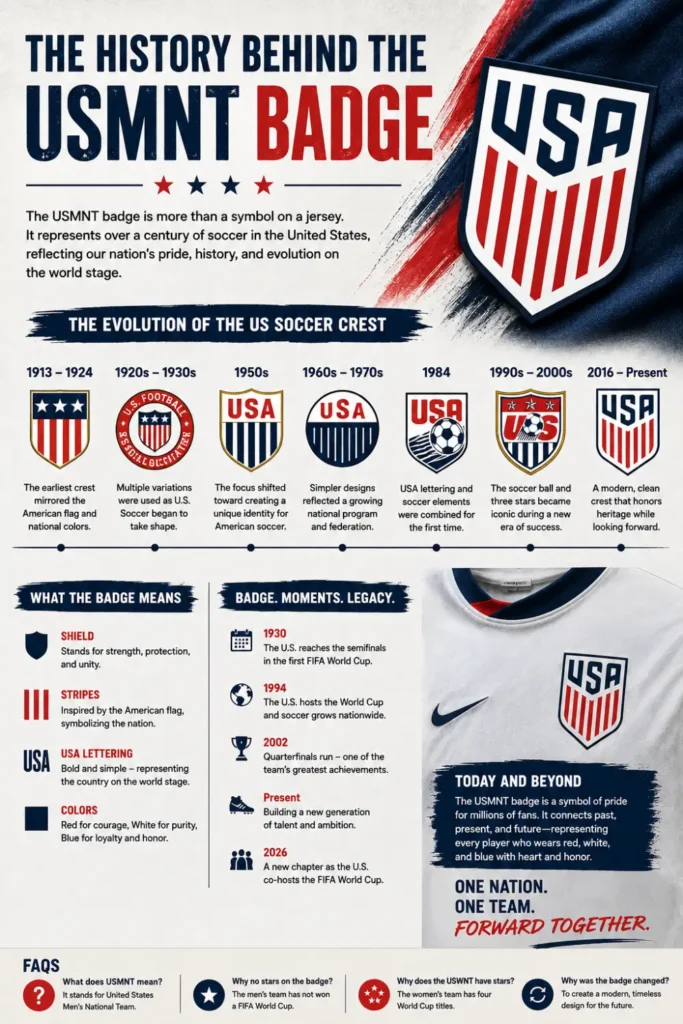
The Evolution of the USMNT Badge at a Glance
The badge’s history can be understood as a gradual movement from national symbolism toward a combination of national and soccer identity. The earliest designs were closely tied to the American flag, while later versions introduced more obvious soccer elements.
The 2016 redesign then moved in the opposite direction by removing the soccer ball and other decorative features. Instead of making the badge more complicated, U.S. Soccer made it simpler and returned the focus to USA and the American flag.
| Era | Main identity | Major feature |
|---|---|---|
| 1910s–1920s | National identity | Stars and stripes |
| 1930s–1970s | Changing federation identity | Multiple logo styles |
| 1980s | Emerging soccer identity | Shield and USA elements |
| 1990s–2000s | Modern soccer identity | Soccer ball and stars |
| 2010s | Transition | Simplified shield |
| 2016–present | National identity with modern design | USA and vertical stripes |
This evolution shows that the badge was never completely disconnected from American history. Even when soccer imagery became stronger, the colors and national references remained important.
What the USMNT Badge Represents Today
Today, the USMNT badge represents the United States on the international soccer stage. Its most important message is simple: USA. The red and white stripes connect it to the national flag, while the shield gives it the appearance of a traditional sports crest.
The badge also represents the growth of American soccer. It has changed through periods when the sport was less established, periods of major World Cup success and disappointment, and the rapid growth of the modern game in the United States.
That makes the crest more than a piece of graphic design. It is a visual record of how U.S. Soccer has developed over more than a century.
- It represents the United States
- It identifies U.S. Soccer
- It connects the team with the American flag
- It reflects the growth of soccer in the country
- It carries memories from different generations of fans
Frequently Asked Questions About the USMNT Badge
What does the USMNT badge represent?
The badge represents the United States in international soccer and is built around USA lettering and American flag-inspired colors.
When was the current USMNT badge introduced?
The current U.S. Soccer crest was introduced in 2016 as a simpler replacement for the previous soccer-ball-based design.
Why does the USMNT badge have no stars?
The men’s national team has not won a FIFA World Cup, so it has no World Cup championship stars above the crest.
Why did the old U.S. Soccer badge have three stars?
The three stars were decorative elements within the older design and did not represent three men’s World Cup victories.
What do the red and white stripes mean?
The stripes are inspired by the stripes of the American flag and connect the soccer crest with U.S. national identity.
Why does the badge say USA?
USA clearly identifies the country represented by the national team and is easy to recognize around the world.
Is the USMNT badge the same as the USWNT badge?
The men’s and women’s teams share the core U.S. Soccer crest, although championship stars on their uniforms can be different.
Why does the USWNT have four stars?
The USWNT has four Women’s World Cup championships, represented by four stars on its uniforms. U.S. Soccer added the fourth star after the 2019 World Cup.
Did the original U.S. Soccer badge look like today’s badge?
No. Early versions were much more closely connected to the American flag, and the crest went through many changes before reaching the modern 2016 design.
What happened to the soccer ball on the old badge?
The soccer ball was removed during the 2016 redesign as U.S. Soccer moved toward a simpler and more modern crest.
Conclusion
The history behind the USMNT badge is really the history of American soccer identity. The earliest designs relied heavily on the American flag, while later versions introduced shields, soccer balls, stars and different forms of USA lettering.
The 2016 redesign brought the identity back to a simpler idea. The modern crest uses a shield, USA lettering and red and white stripes inspired by the American flag. It does not need a soccer ball or decorative stars to explain what it represents.
As the United States continues to grow as a soccer nation, the badge will remain an important symbol of that journey. From the early national teams to the 1994 World Cup and the modern 2026 era, different generations have worn different versions of the crest. Yet the central message has remained the same: USA represents the country on the international soccer stage.